Why One Partner Pushes and the Other Pulls Away
One partner wants to talk now. The other needs space. The harder one pushes, the farther the other pulls away. Understanding this cycle can help couples respond differently.

One partner wants to talk about what happened. The other wants the conversation to stop. The more one person presses for an answer, reassurance, or resolution, the more the other seems to shut down, become defensive, or pull away.
From the outside, it can look like one person cares too much and the other does not care enough. Inside the relationship, it often feels very different. Both partners may be trying to protect something important—and each person’s way of coping can unintentionally intensify the other’s reaction.
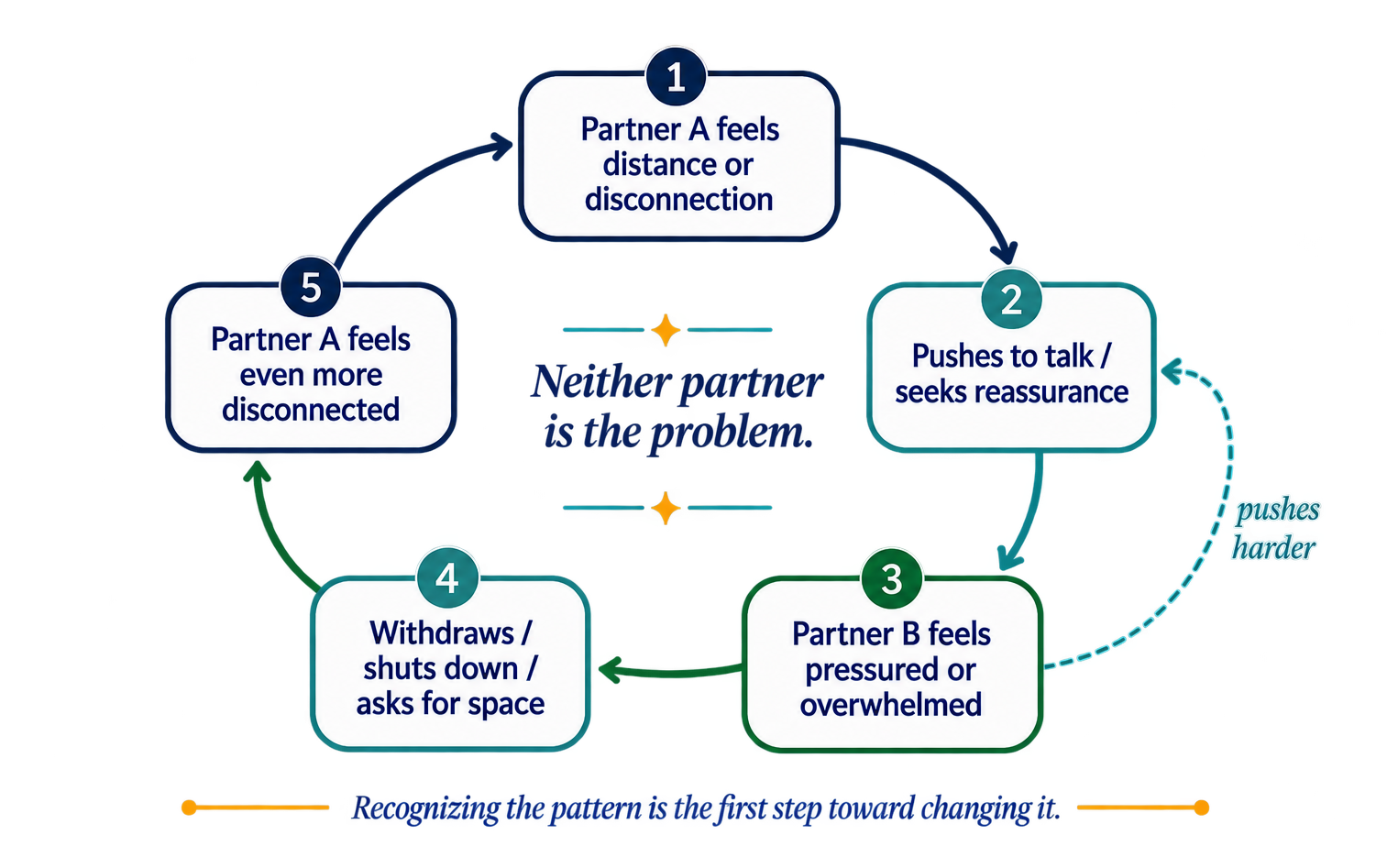
The harder one partner pushes, the farther the other may pull away
When one person feels distance, uncertainty, or disconnection, talking can feel urgent. They may ask more questions, repeat the concern, raise the intensity, or try harder to get their partner to engage.
The other partner may experience that same intensity as criticism, pressure, or a conversation they cannot handle well in the moment. Pulling back, going quiet, changing the subject, or asking for space may feel like the safest way to keep things from getting worse.
The difficulty is that withdrawal can make the first partner feel even more alone or unimportant. That often increases the urgency to reconnect—which can lead to even more pursuit.
Both partners usually end up feeling misunderstood
The pursuing partner may think, “If you cared, you would stay in this conversation with me.”
The withdrawing partner may think, “If you understood how overwhelmed I feel, you would stop pushing me.”
Each person sees the other’s reaction but may not see the fear, hurt, pressure, or longing underneath it. Over time, the cycle can become so familiar that both partners begin reacting to what they expect will happen before the conversation has really begun.
What each partner may be protecting
The partner who pushes for the conversation may be trying to protect the relationship from distance. Silence can feel like disconnection, rejection, or a sign that the problem does not matter. Continuing the conversation may be an attempt to restore closeness, get reassurance, or make sure the relationship is still secure.
The partner who pulls away may be trying to protect the relationship from escalation. They may feel flooded, criticized, inadequate, or afraid they will say the wrong thing. Stepping back can feel like the best way to calm things down, avoid making the conflict worse, or regain enough control to think clearly.
In other words, both partners may be responding to a threat to the relationship, but in opposite ways.
The cycle becomes the problem
The longer this pattern continues, the easier it is for each partner to interpret the other’s behavior in the worst possible way. Pursuit can start to look controlling. Withdrawal can start to look uncaring. Both partners may become more certain that the other person is the reason the conversation keeps failing.
But when couples can begin to see the pattern itself as the problem, something changes. Instead of asking, “Why are you doing this to me?” they can start asking, “What happens between us when we both get pulled into this cycle?”
That shift does not solve the conflict by itself, but it creates a better starting point for responding differently.
How to interrupt the push-pull cycle
Changing this pattern usually begins with noticing it earlier. By the time both partners are highly activated, it can be much harder to respond differently.
The pursuing partner may need to slow the urgency enough to express what is underneath the pressure more directly. Instead of repeating the argument or demanding an immediate response, it can help to name the need more clearly: reassurance, closeness, understanding, or a sense that the issue matters.
The withdrawing partner may need to communicate that stepping back is not the same as abandoning the conversation. Asking for a pause can be helpful when it includes a clear commitment to return, rather than ending the discussion indefinitely.
A pause works better when there is a plan to reconnect
“I need a little time to calm down” can feel very different from “I’m done talking about this.”
If one partner needs space, agreeing on when to return to the conversation can reduce the sense of abandonment for the pursuing partner while giving the withdrawing partner time to regulate.
For example:
“I want to talk about this, but I’m getting overwhelmed. Can we take 30 minutes and come back to it at 7:30?”
The important part is not the exact amount of time. It is the message underneath it: I am stepping away from the intensity, not stepping away from you.
The goal is not to force immediate resolution. It is to make the conversation feel safer and more predictable for both people.
Try to name what is happening between you
Sometimes the most useful thing a couple can do is pause the content of the argument and name the pattern itself.
You might notice:
“I’m pushing harder because I’m afraid we are disconnecting.”
Or:
“I’m pulling away because I feel overwhelmed and worried I’ll make this worse.”
This changes the conversation from:
You are the problem.
to:
We are getting caught in something together.
That distinction matters.
When partners can recognize the cycle while it is happening, they have a better opportunity to respond to what the other person is actually experiencing instead of reacting only to the behavior they see.
Look underneath the reaction
When conflict becomes repetitive, it can help to become curious about what the reaction is protecting.
If you are the partner who tends to pursue, you might ask yourself:
- What am I afraid will happen if we do not resolve this right now?
- What am I hoping my partner will understand or reassure me about?
- Is there a softer feeling underneath my anger or urgency?
If you are the partner who tends to withdraw, you might ask yourself:
- What starts happening inside me when the conversation becomes intense?
- Am I afraid of disappointing my partner, failing, or making things worse?
- What would help me stay emotionally present without becoming overwhelmed?
These questions are not about blaming yourself for the pattern. They are a way of understanding what happens just before the familiar reactions take over.
Both partners may need to do something different
Push-pull patterns rarely change because one person simply agrees to stop pursuing or the other agrees to stop withdrawing.
Both partners usually need a new response.
The pursuing partner may practice expressing the need underneath the urgency with less pressure.
The withdrawing partner may practice staying emotionally available while setting clearer limits around when and how difficult conversations happen.
That might sound like:
“When you go quiet, I start worrying that what I’m feeling does not matter. What I really need right now is to know that you are still with me.”
And the response might be:
“I am still with you. I’m getting overwhelmed, but I do want to understand. Can we slow this down?”
Neither response requires the couple to agree immediately.
The goal is to create enough safety for both people to remain connected while working through the disagreement.
When the cycle keeps coming back
Recognizing the pattern does not always mean a couple can easily change it.
These responses often become automatic over time. Couples may understand perfectly well that pursuing makes withdrawal worse and that withdrawal makes pursuit stronger—and still find themselves doing exactly the same thing during the next argument.
That does not necessarily mean either partner is unwilling to change. It may mean the cycle has become difficult to interrupt from inside the relationship.
Couples counseling can provide a place to slow these interactions down, understand what each partner is experiencing underneath the reaction, and practice responding differently while the pattern is actually happening.
If this push-pull cycle feels familiar in your relationship, you can learn more about couples counseling for recurring conflict.
You can also read more about my broader approach to couples counseling.
The pattern is not the relationship
A recurring cycle can become so dominant that couples begin to define themselves by it.
“We cannot communicate.”
“She always pushes.”
“He always shuts down.”
“We are just bad together.”
But the pattern is something that happens between two people. It is not the entirety of either person, and it does not have to define the relationship.
Learning to recognize the cycle can create a small but important shift: instead of fighting each other, partners can begin learning how to face the pattern together.
Interested in working together?
Schedule a consultation.
Choose a time that works for you so we can briefly discuss what you are looking for and whether the next step makes sense.

Written by

